Don’t guess – test!
Many ideas do not fail because they are bad. They fail because they were never tested.
Every business idea is based on assumptions, and many of them are riskier than they appear at first glance. Therefore, think of your venture as an experiment: your idea is the hypothesis that needs to be tested.
The key questions are:
- Is there really demand for my offering?
- Are people willing to pay for it?
- Is the solution technically and operationally feasible at all?
The greater your uncertainty in answering these questions, the earlier you should test them. And you do not need a large budget for this – only creative curiosity.
A real-world example
A team is planning an online marketplace for second-hand kitchens. Instead of building a platform right away, they start with a simple Instagram page and post initial offers.
This way, they test: Which kitchens get attention? Which price ranges are accepted by buyers? What turns people away?
The result: plenty of valuable feedback before a single line of code was written.
How you can test
Interviews, prototypes, landing pages, simple social media campaigns – there are many ways to validate assumptions quickly and cheaply. The principle is always the same: as early, as fast, and as cost-efficient as possible.
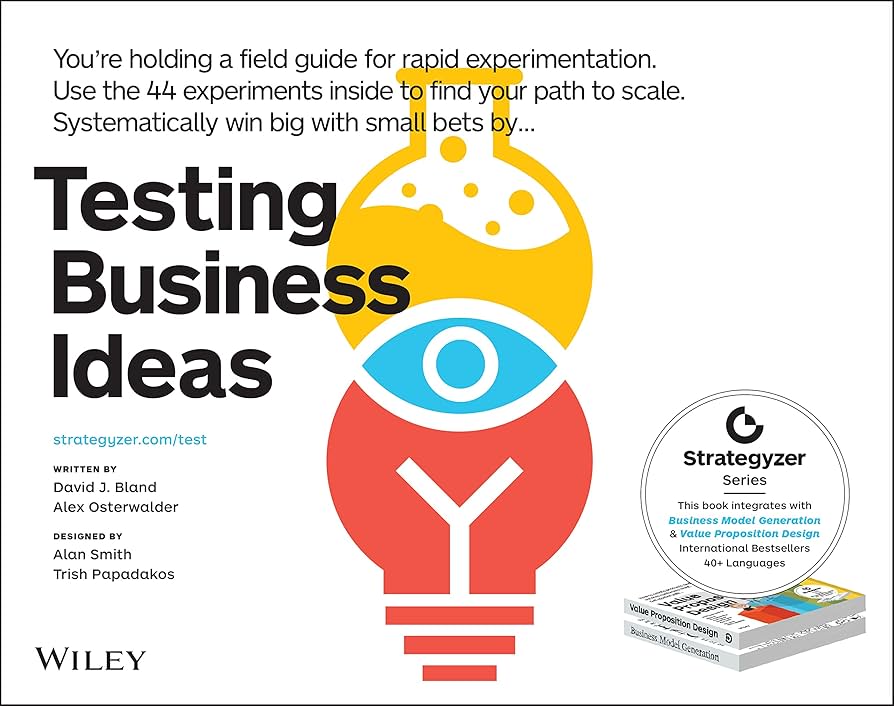
A particularly useful resource for this is “Testing Business Ideas” by Alexander Osterwalder. The book is a companion to the well-known Business Model Canvas. It presents over 40 concrete testing methods, ranging from quick and simple approaches to more complex experiments. It also provides a framework for prioritizing risks, selecting appropriate methods, and evaluating results in a data-driven way.
💡 For reflection: Which three assumptions in your business idea are you most uncertain about? Write them down briefly – and consider how you could test one of them within the next two weeks using a simple experiment.
You can find a free excerpt of the book “Testing Business Ideas”, which we refer to here.